How to Find Your Color Season — 3 Free Methods
There are three reliable ways to find your color season — a photo analysis tool, a conversational AI, and an 8-question quiz. All three are free, take under 3 minutes, and require no signup. Here is how each works, when to use each one, and how to confirm your result.
Find My Season Free NowBefore You Start — What You Need to Know
Seasonal color analysis is based on three factors: skin undertone, hair color, and eye color. Of these, skin undertone is the most important — it determines whether you are warm (Spring or Autumn) or cool (Summer or Winter). Hair and eye color then narrow down your exact season and sub-season within that broad category.
For the most accurate result from any method, follow these principles before you begin:
Use Natural Light
All tests — photo, quiz, and home tests — work best in natural daylight. Indoor artificial lighting distorts color perception significantly, especially warm bulbs which make cool undertones look warm.
No Makeup
Foundation, blush, and bronzer all alter the apparent color of your skin. The photo tool samples your actual skin color — makeup on top gives the wrong reading. Bare face only for the most accurate result.
Natural Hair if Possible
Dyed hair changes the hair color input significantly. If your hair is dyed, use your eyebrow color as the hair reference for quiz questions — eyebrows retain your natural tone more reliably.
For Photos — Face the Camera
For the photo tool, face the camera directly in neutral daylight. Avoid backlighting, shadows across the face, or heavily filtered images. The clearer the photo, the more accurate the color sampling.
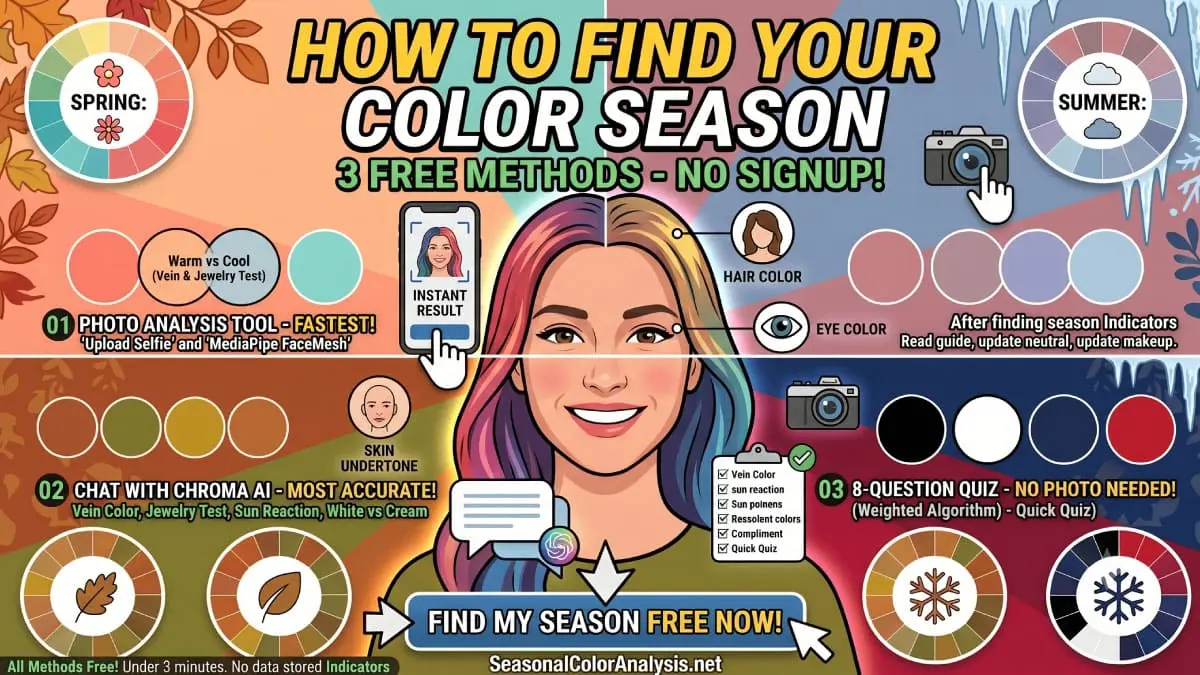
The Three Methods
Photo Analysis Tool — Fastest
Upload a selfie or use your camera live. Our tool uses Google MediaPipe FaceMesh to map 468 facial landmarks and sample pixel color values from three zones: the cheek area (skin), the iris (eye color), and the hair region above the forehead. A warmth classification algorithm converts these RGB values into a seasonal result with a confidence score and warmth score.
Best for: People who want an instant result without answering questions. Works in under 30 seconds.
Accuracy: 75–85% for the broad season in good natural lighting. The most common cause of error is indoor warm lighting or heavy foundation distorting the skin sample.
After your result: Use the "Discuss with Chroma" button to open the AI chat pre-loaded with your color data — Chroma will confirm or refine your result and give you wardrobe, makeup, and style advice immediately.
Try the photo tool →Chat with Chroma AI — Most Accurate
Chroma is our AI color consultant. Rather than analyzing a photo, Chroma holds a real conversation — asking the same diagnostic questions a professional color analyst would ask in a draping session: vein color in natural light, gold versus silver jewelry preference, sun reaction, eye color, natural hair color, and how white versus cream looks near your face.
Best for: People who want the most nuanced result — particularly those with ambiguous photo results, dyed hair, or complex coloring. Also the best choice if you already know your broad season and want sub-season advice, wardrobe direction, or makeup guidance.
Accuracy: Often more reliable than the photo tool because it is not affected by lighting, makeup, or photo quality. The conversational format allows follow-up questions that a fixed quiz cannot provide.
Privacy: No photo is taken or stored. The conversation is not saved after your session ends.
Chat with Chroma →8-Question Quiz — No Photo Needed
The quiz covers all eight key diagnostic questions: vein color, sun reaction, jewelry preference, natural hair color, eye color, how white versus cream looks near your face, overall skin depth, and which color group you most often receive compliments in. Each question contributes to the seasonal algorithm with weighted scoring.
Best for: People who prefer not to upload a photo, who have very short or shaved hair (where the photo tool struggles), or who want a second method to cross-check a photo result.
Accuracy: Highly reliable when you answer based on your natural, undyed coloring. Less reliable for people with significantly dyed hair who cannot recall their natural shade accurately.
Takes: Under 2 minutes. No signup, no data stored.
Take the quiz →Step-by-Step: How to Find Your Season
If you want to work through the logic manually — or cross-check your tool result — here is the same process a professional color analyst uses.
Determine Your Undertone — Warm or Cool
This is the single most important step. Look at your inner wrist veins in natural daylight. Green or olive veins indicate warm undertone — you are in the Spring or Autumn family. Blue or purple veins indicate cool undertone — you are in the Summer or Winter family.
Confirm with the jewelry test: hold gold and silver next to your face. Whichever looks more natural confirms your direction. Read our full undertone guide for six tests.
Determine Your Depth — Light or Deep
Within your warm or cool family, are you lighter or deeper overall? Look at the combined picture of your skin, hair, and eyes together — not just one element.
Warm + light overall → Spring. Warm + deep overall → Autumn. Cool + light or soft → Summer. Cool + high contrast or deep → Winter.
Narrow Down Your Sub-Season
Once you have your broad season, read all three sub-season descriptions for that season and identify which one most precisely describes your coloring. The key question is usually which adjacent season you bridge toward:
- Spring: Are you delicate and low-contrast (Light Spring), classic and medium-contrast (True Spring), rich and golden (Warm Spring), or vivid and high-contrast (Bright Spring)?
- Summer: Are you classic and balanced (True Summer), hazy and muted (Soft Summer), or crisp and defined (Cool Summer)?
- Autumn: Are you muted and gentle (Soft Autumn), classic and golden (True Autumn), or dark and dramatic (Deep Autumn)?
- Winter: Are you the darkest and most dramatic (Deep Winter), classic and high-contrast (True Winter), or icy and luminous (Cool Winter)?
Confirm with a Color Drape
The most reliable confirmation method is to hold colored fabric next to your bare face in natural daylight — the same process a professional analyst uses. Take one color clearly from your season and one clearly from the opposite season and compare:
- The correct color makes your skin look more even, your eyes look brighter, and your features look more defined
- The wrong color makes shadows appear under your eyes, your skin look sallow or flat, or your features look less defined
- The difference should be apparent within seconds in good natural light
If you are between two seasons, try the boundary test: hold a color from each season next to your face and see which is clearly more flattering. The clearer and more immediate the difference, the more confident you can be in your result.
Common Points of Confusion
These are the most frequent situations where people get an inaccurate result or feel uncertain about their season.
Dyed hair giving the wrong result
If your hair is significantly dyed, the photo tool may sample the wrong hair color. Use your eyebrow color as the hair reference for quiz questions — eyebrows almost always retain your natural tone. For the photo tool, try to test on your most natural hair or use the quiz instead.
Sitting between two seasons
If you genuinely fit between Spring and Summer, or Autumn and Winter, you are almost certainly a bridge sub-season. Soft Summer bridges Summer and Autumn. Light Spring bridges Spring and Summer. Deep Winter bridges Winter and Autumn. Read the 12 seasons guide for all bridge types.
Tanned skin affecting the result
A tan changes your surface skin tone but not your undertone. If you are currently tanned, the photo tool may skew warm. Use the quiz or Chroma chat instead — both ask about your natural undertone directly rather than sampling a photo. Answer based on your natural coloring, not your current tanned appearance.
Indoor lighting distorting tests
Warm indoor bulbs make everyone look warm-undertoned. Fluorescent bulbs make everyone look cool. Never do any undertone test under artificial light. If you cannot get natural daylight, do the tests near a window facing away from direct sun — indirect natural light is better than any artificial alternative.
What to Do After You Find Your Season
Your season result is a starting point, not a rigid prescription. Here is how to make use of it immediately.
Read Your Season Guide
Every season has a full dedicated guide on this site with your complete palette, colors to avoid, best neutrals, metals, makeup direction, and wardrobe tips. Start there.
Identify Your Best Neutral
The single highest-impact decision is your foundational neutral — the color that replaces grey or black as your wardrobe anchor. Warm seasons: camel or olive. Cool seasons: grey or navy. Identifying this one thing changes every outfit.
Update Your Makeup
Check your current foundation, blush, and lip color against your season. The wrong undertone in foundation is the most common and most visible wardrobe mistake people make — and the easiest to fix.
Ask Chroma Specific Questions
Once you know your season, Chroma can answer specific questions — what coat suits a True Autumn, which lipstick shades work for Cool Summer, which metals to buy. Tell Chroma your season and ask anything.
How to Find Your Color Season — Common Questions
Find Your Color Season Free — Right Now
Photo tool, quiz, or AI chat — three ways to get your result in under 3 minutes.