Winter Color Season — Seasonal Color Analysis Guide
Winter is the most high-contrast and striking of the four seasons in seasonal color analysis. Cool undertones, vivid clarity, and strong contrast between features — true black, pure white, and jewel tones are your natural signature.
Find My Season FreeAre You a Winter in Seasonal Color Analysis?
Winter is defined by coolness and contrast. Your natural coloring has a striking, graphic quality — strong contrast between your features, clearly cool undertones, and a natural tendency toward bold, high-impact looks. When you wear colors from your palette, the effect is immediate: you look sharper, more awake, and more defined. If colors ever look flat or washed-out on you, it is usually a sign that they are too warm or too muted — Winter types need cool, clear, and saturated to come alive.
Skin
Fair with cool pink or porcelain undertone, cool olive, or deep skin with a cool or neutral cast. The key is a clearly cool quality — no golden warmth visible anywhere. Winters span the full depth range.
Eyes
Cool dark brown, black-brown, clear blue, grey-blue, or cool grey. Often described as striking or intense. There is strong contrast between the iris and the whites of the eye.
Hair
Dark brown to black with no warm undertone, cool ash brown, or platinum blonde. Hair reads as cool and deep — blue-black in some cases. No golden, reddish, or warm quality.
Undertone
Cool — your veins appear blue or purple on the inner wrist, silver jewelry flatters more than gold, and you look sallow or dull in warm beige, camel, or orange near your face.
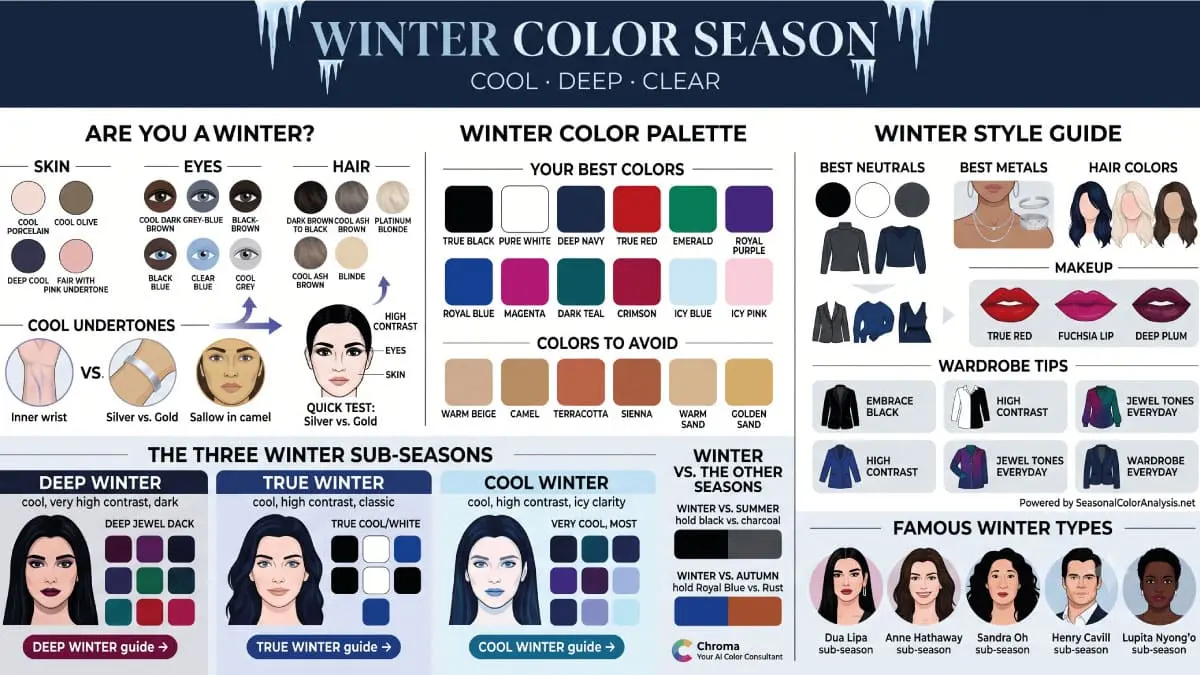
Winter Color Palette
Winter colors are cool, clear, and high-contrast — think midnight navy, true black, crisp white, vivid jewel tones, and icy pastels. Every color in your palette is either very deep and saturated or very clear and icy. Nothing warm, nothing muted, nothing dusty or earthy.
Your Best Colors
Colors to Avoid
Warm, earthy, or muted colors clash immediately with your cool high-contrast coloring — they make you look sallow, dull, or visibly unwell near your face.
Winter Style Guide
Best Neutrals
True black, pure white, charcoal, and deep navy. Unlike most seasons, black is your most flattering neutral — not just acceptable. Avoid camel, warm beige, and warm brown entirely.
Best Metals
Silver, white gold, and platinum. These cool metals complement your undertone perfectly. Yellow gold reads as too warm and casual against Winter's sharp, cool coloring.
Hair Colors
If coloring hair, stay cool and deep: cool dark brown, blue-black, or platinum blonde. Avoid warm, golden, copper, or reddish tones at any depth — they fight your natural cool base.
Makeup
True red, cool berry, vivid fuchsia, or deep plum lip. Cool pink or cool beige foundation. Silver or cool highlight. Avoid warm bronze, peachy blush, or golden anything.
Wardrobe Tips
- Embrace black fully and without guilt. True black is your most flattering neutral and looks more natural on you than on any other season. A black top near your face will sharpen your coloring rather than harshening it.
- High contrast outfits work for you. Black and white, navy and white, deep burgundy and ivory — the combinations that look costume on others look intentional and powerful on Winter.
- Jewel tones — sapphire, emerald, ruby, amethyst, deep teal — are everyday colors for you. Wear them as your version of what other seasons call neutrals.
- Silver accessories only. Swap gold hardware in bags and belts for silver or gunmetal. The difference against your cool coloring is immediately visible.
- A vivid true red lip is your most iconic look — cool-based, neither orange nor blue-pink, simply clear red. It takes seconds and reads as effortlessly pulled-together on Winter.
- Icy pastels — icy blue, icy pink, icy violet — work where regular pastels fail. They have enough blue-cool base to suit your undertone without looking washed out.
- When warm trends cycle through — camel, terracotta, mustard — keep them below the waist. Further from your face, the undertone clash is far less visible.
The Three Winter Sub-Seasons
Seasonal color analysis divides Winter into three sub-seasons based on depth, darkness, and clarity. All three share cool undertones and high contrast — the differences are in how dark, how vivid, and how purely cool each type runs. Use our free seasonal color analysis tool to find which one you are, then read the full sub-season profile.
Deep Winter
Cool · Very high contrast · Dark. The Winter-Autumn bridge. The darkest Winter type — near-black hair, very deep coloring overall, and slightly warmer than True Winter while still firmly cool. High contrast is the defining feature.
True Winter
Cool · High contrast · Classic. The purest Winter — balanced between deep and icy, clearly cool throughout. True black, pure white, royal blue, and vivid jewel tones are your signature. The most classic Winter type.
Cool Winter
Cool · High contrast · Icy clarity. The Winter-Summer bridge. The most intensely cool and icy Winter type — almost blue-cool in quality. Icy pastels and vivid electric colors sit alongside deep tones in your palette.
Winter vs. the Other Seasons
The most common points of confusion are Winter vs. Summer (both cool) and Winter vs. Autumn (both deep). Here is how to distinguish them — or take our seasonal color analysis quiz to get a definitive answer.
Winter vs. Summer
Both cool — the difference is contrast and saturation. Summer is soft, muted, and low-contrast. Winter is vivid, high-contrast, and clear. Hold true black next to your face: if it sharpens and flatters you, you are Winter. If it looks harsh and charcoal suits you better, look at Summer.
Winter vs. Autumn
Both can be deep — the difference is temperature. Autumn is warm and earthy; Winter is cool and clear. Hold a warm rust and a vivid royal blue next to your face. If royal blue sharpens your features and rust dulls you, you are Winter. If rust looks natural and blue seems too harsh, look at Autumn.
Famous Winter Types
These public figures are frequently cited in seasonal color analysis as Winter examples. Notice how black, white, true red, and jewel tones look natural and powerful on them — while warm or muted tones immediately flatten their strong coloring.
- Dua Lipa — very dark hair, cool fair skin, and striking cool features. The graphic black-and-white combination and vivid jewel tones are consistently her most powerful looks on stage and in print.
- Anne Hathaway — dark hair, fair cool skin, and dark striking eyes. True red lipstick is her signature — one of the clearest True Winter looks in Hollywood.
- Sandra Oh — dark hair, cool olive skin, and dark cool eyes. The vivid, high-contrast palette of Winter at its most striking across warm-cool olive coloring.
- Henry Cavill — Winter applies equally to men. Near-black hair, cool fair skin, and sharp blue eyes — black suits, true navy, and cool charcoal are visibly his strongest colors.
- Lupita Nyong'o — deep dark skin with cool cast, dark hair, and striking eyes. Winter at deep depth — jewel tones and pure white are consistently her most striking looks.
Winter Color Season — Common Questions
Find Your Season with Free Seasonal Color Analysis
Upload a photo or take the 8-question quiz — your personal Winter palette in under 2 minutes.