Warm Spring Color Season
The purest and most golden expression of Spring — rich warm coloring, sun-kissed radiance, and a naturally generous palette that can carry more saturation than any other Spring type.
Find Your Season FreeWhat Is Warm Spring?
Warm Spring is the most purely warm-toned of the three Spring sub-seasons in seasonal color analysis — if Spring had to be distilled to a single golden essence, this is it. Where Light Spring is delicate and airy and True Spring sits at medium saturation, Warm Spring runs the richest and most saturated of the three. Your coloring is unmistakably warm in every feature simultaneously.
Warm Spring bridges Spring toward Autumn — you share the warm undertone of True Autumn but with Spring's lighter, clearer, more luminous quality rather than Autumn's deep earthiness. Your palette is golden and generous — you can wear more color, more saturation, and more richness than any other Spring type.
Skin
Golden beige, peachy tan, warm bronze, or warm olive. You often tan easily and maintain a sun-kissed quality at baseline. Clear warm undertone — golden or peachy rather than pink or cool.
Eyes
Warm brown, amber, hazel with golden or copper flecks, golden green, or topaz. A warm, fire-like quality to the iris — rich and glowing rather than cool or misty.
Hair
Warm red, auburn, copper, golden brown, or dark golden blonde. Warm and rich in tone — noticeably warm even in photographs. No ash, cool brown, or neutral quality.
Contrast
Low to medium contrast — features are warm and harmonious rather than sharply differentiated. Everything reads as richly warm rather than dramatically contrasted.
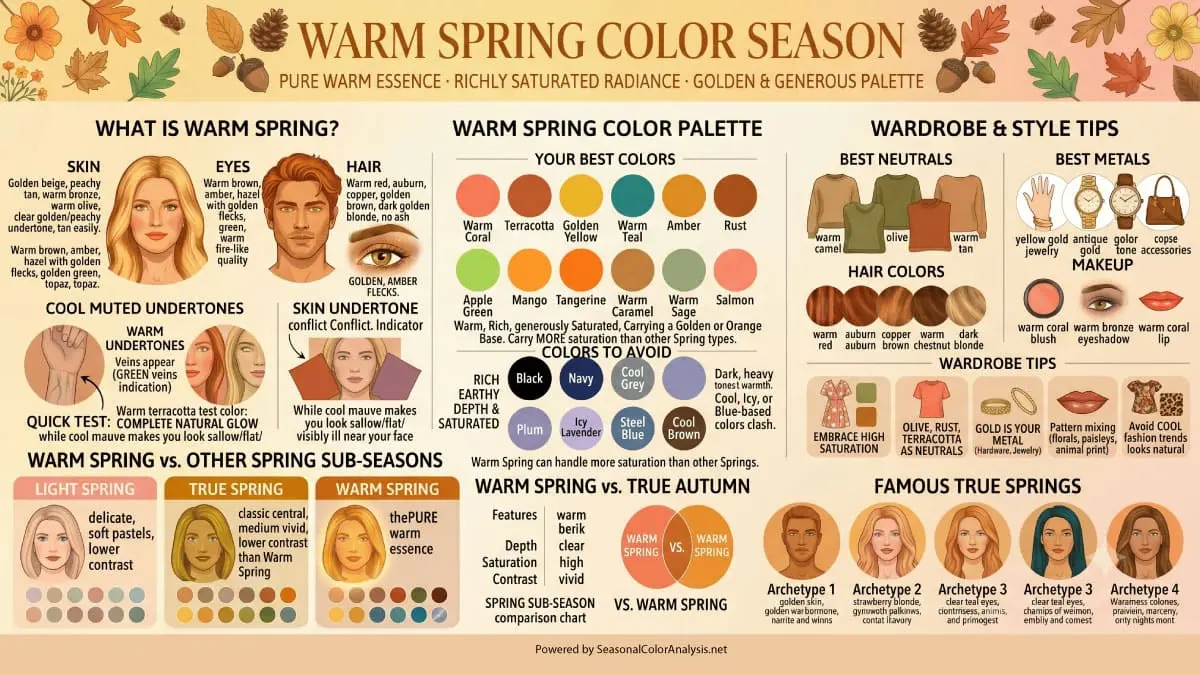
Warm Spring Color Palette
Your palette is warm, rich, and generously saturated — think sunflower fields, ripe mangoes, terracotta pots, and warm spice markets. Every color has a golden or orange base and can be worn at a higher saturation than other Spring types can handle. Nothing cool, nothing muted, nothing that reads as cold or blue-based.
Your Best Colors
Colors to Avoid
Cool, icy, or blue-based colors fight your richly warm coloring — they make you look sallow, flat, and visibly wrong near your face. Even dark, heavy tones without warmth drain Warm Spring coloring.
Warm Spring Coloring in Depth
Skin undertone
Warm Spring skin has the most purely warm undertone of any Spring type — golden, peachy-orange, or warm olive with no cool or pink quality whatsoever. The skin often has a naturally sun-kissed quality even without sun exposure. In cool grey or blue-pink near the face, Warm Spring skin looks immediately sallow and flat — that contrast is one of the most reliable ways to confirm your warm base. Unlike True Autumn, which has a similar warm undertone but more depth, Warm Spring skin retains a luminous, lighter quality even at deeper skin tones.
Eye color
Warm Spring eyes carry a distinctly warm, fire-like quality — amber, hazel with golden or copper flecks, warm topaz green, or warm golden brown. The warmth is visible in the eye itself rather than just the surrounding features. Where True Spring eyes lean toward clarity and brightness, Warm Spring eyes lean toward depth and richness — golden rather than vivid, warm rather than sparkly.
Hair color
Natural Warm Spring hair is unmistakably warm — copper, auburn, warm chestnut, golden brown, or dark golden blonde. In sunlight it shows intense golden, copper, or amber highlights. The warm quality is immediately visible even in photographs. Warm Spring hair is typically richer and more saturated in warmth than True Spring hair — this is part of what places it as the Spring-Autumn bridge type.
Warm Spring Style Guide
Best Neutrals
Warm camel, olive, rust, and warm tan. These are your everyday neutrals — they function the way grey and navy work for other people. Avoid black and cool grey entirely near your face.
Best Metals
Yellow gold in warm tones — classic gold, antique gold, and copper. These reflect your undertone and look completely natural. Silver, white gold, and platinum read as too cool and stark.
Hair Colors
Stay warm and rich: copper highlights, warm auburn, golden brown, warm chestnut, or warm red. Avoid ash, platinum, cool blonde, and any color described as cool or neutral in tone.
Makeup
Warm coral or warm peach blush, warm bronze or copper eyeshadow, and warm coral, warm red, or terracotta lip. Avoid cool pink, berry, mauve, and any grey-toned neutrals.
Wardrobe Tips
- You can wear more color than any other Spring type — embrace warm, rich, saturated tones with full confidence. Where True Spring might find vivid terracotta slightly strong, it is completely natural on you.
- Olive, rust, and terracotta function as neutrals in your wardrobe. Build your base here rather than in grey or black — a warm olive trousers and camel knitwear combination is your version of grey trousers and white shirt.
- Gold is your metal in every form — jewelry, bag hardware, belt buckles, shoe details. Yellow gold and warm bronze look completely natural against your warm coloring.
- Warm coral and warm red lipstick look extraordinary on Warm Spring — these are your power lip colors. Cooler berry, plum, or mauve tones fight your undertone immediately.
- Pattern mixing works beautifully when the colors stay warm — florals, paisleys, and animal prints in warm tones look intentional and natural, not overwhelming.
- Warm green — jungle green, khaki, olive — is among your strongest neutral-replacing options and works as an anchor color across your entire wardrobe.
- Avoid cool fashion trends: icy pastels, steel blue, lavender, and cool grey are never your palette regardless of the season they appear in.
Warm Spring Makeup Guide
Foundation
Warm golden beige, peachy tan, or warm neutral. Look for shades described as warm, golden, or peachy. Your skin often has a warm olive or golden quality that needs a matching base — avoid pink-toned or neutral-cool foundations entirely.
Blush
Warm coral, warm peach, or warm apricot — richer and more saturated than True Spring blush. These deepen and warm your natural flush beautifully. Avoid cool pink, mauve, or rose-beige blush entirely.
Eyes
Warm bronze, rich copper, warm golden brown, or warm olive eyeshadow. Warm teal or warm brown liner. Your warm eyes come alive with rich, warm shadow — use it generously. Avoid cool grey, ashy taupe, charcoal, and silver.
Lips
Warm coral, warm orange-red, terracotta, warm amber-red, or rich warm peach. These are your signature lip shades — rich, warm, and completely natural-looking. Avoid berry, plum, cool pink, mauve, and muted dusty tones.
Warm Spring vs. the Other Spring Sub-Seasons
All three Spring sub-seasons are warm-undertoned — the differences are in saturation, depth, and richness. Use these comparisons to confirm your type, or take our free seasonal color analysis to check.
Light Spring
Warm · Very low contrast · Delicate. The lightest and most airy Spring type. Where Warm Spring can carry rich terracotta and bold warm teal, Light Spring suits soft warm pastels and is overwhelmed by the same saturation that flatters you.
True Spring
Warm · Medium contrast · Clear. The classic central Spring. True Spring can handle medium saturation but finds very rich, deeply warm colors slightly overwhelming. If you find True Spring's palette feels slightly too light or fresh, Warm Spring is your direction.
Famous Warm Spring Types
These public figures are frequently cited in seasonal color analysis as Warm Spring examples. Notice how rich golden tones — warm terracotta, amber, warm teal, and copper — look completely natural and powerful on them.
- Jessica Simpson — golden blonde hair, warm golden skin, and warm amber-hazel eyes. The rich golden warmth running through all features simultaneously is characteristic of Warm Spring at its most classic.
- Jennifer Lopez — warm golden-olive skin, warm brown to auburn hair, and warm brown eyes. Rich, warm, and luminous — the Warm Spring palette of terracotta, amber, and warm teal is consistently her most powerful direction.
- Beyoncé (natural coloring and lighter phases) — warm golden skin and warm brown to auburn hair. The richly warm, sun-kissed quality of Warm Spring coloring at its most striking.
- Matthew McConaughey — Warm Spring coloring applies equally to men. Golden-tan skin, warm golden-brown hair, and warm hazel eyes — camel, terracotta, and warm olive consistently outperform cool tones on him.
Warm Spring — Common Questions
Confirm Your Season with Free Seasonal Color Analysis
Take the free quiz or upload a selfie — find out if Warm Spring is your match in under 2 minutes.