Spring Color Season — Seasonal Color Analysis Guide
Spring is the warmest and most luminous of the four seasons in seasonal color analysis. If you have warm golden undertones, light or warm hair, and clear bright eyes, Spring colors will make you glow.
Find My Season FreeAre You a Spring in Seasonal Color Analysis?
Spring is defined by warmth and clarity. Your natural coloring has a golden, peachy, or warm quality that runs through your skin, hair, and eyes together — and when you wear colors from your palette, the effect is immediate: you look fresher, brighter, and more awake. If colors from your palette ever look too strong or too muted, it is usually a sign that your specific sub-season (Light, True, or Bright Spring) needs adjusting — not that Spring is wrong.
Skin
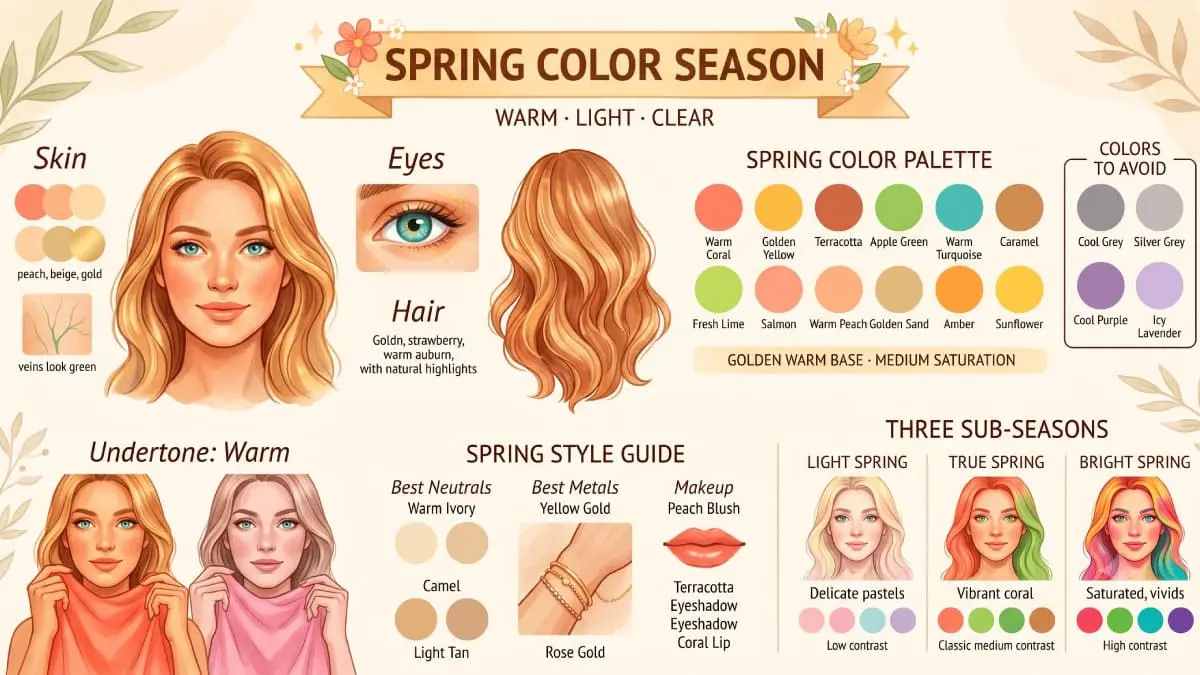
Warm ivory, peachy beige, golden tan, or warm olive. Your skin has a clear golden or peachy undertone — not pinkish, ashy, or cool. Light freckles are common in Spring types.
Eyes
Clear blue, warm green, teal, turquoise, or warm hazel with golden or amber flecks. Often described as bright or striking. The clarity is as important as the color itself.
Hair
Golden blonde, strawberry blonde, warm light brown, auburn, or copper. Natural highlights appear in sunlight. Rarely very dark at birth — if so, Bright Spring may be a better fit.
Undertone
Warm — your veins appear greenish on the inner wrist, gold jewelry flatters more than silver, and you look sallow or flat in cool grey or lavender near your face.
Spring Color Palette
Spring colors are warm, clear, and medium-saturated — think sunlit peaches, warm corals, fresh apple green, and clear warm turquoise. Every color in your palette has a golden warm base. Nothing cool, nothing too dark, nothing dusty.
Your Best Colors
Colors to Avoid
These colors fight your warm undertone and will make you look washed out, tired, or older. Keep them away from your face — especially in tops and scarves.
Spring Style Guide
Best Neutrals
Warm ivory, camel, warm beige, and light tan. These replace black and cool grey as your everyday neutrals. Warm white rather than stark white near your face.
Best Metals
Yellow gold and rose gold. These reflect your warm undertone. Silver and platinum read as too cool and stark against Spring coloring.
Hair Colors
Stay in the warm family when coloring hair: honey blonde, golden brown, strawberry highlights, copper, and warm auburn. Avoid ash, platinum, or cool tones.
Makeup
Peach or coral blush, warm brown or terracotta eyeshadow, coral or warm red lip. Avoid cool pink, berry, mauve, or grey-toned neutrals in any category.
Wardrobe Tips
- Build your base around warm ivory, camel, and tan — not white, black, or cool grey. These neutrals complement rather than fight your coloring.
- Coral is your single most powerful color. A warm coral top will immediately make your skin glow, your eyes look brighter, and your features more defined.
- Denim works best in light-to-medium warm washes. Very dark indigo or black denim creates too much contrast and looks harsh against Spring coloring.
- Florals, tropical prints, and warm patterns in your palette colors look natural and intentional — use them freely where others might hesitate.
- For eveningwear, vivid warm coral, golden yellow, or warm turquoise are striking and completely right — you do not need black to look dressed up.
- Avoid cool-toned fashion trends when they cycle through — icy pastels, cool lavender, and steel grey are not your palette regardless of what is in season.
The Three Spring Sub-Seasons
Seasonal color analysis divides Spring into three sub-seasons based on contrast, depth, and saturation. All three share warm undertones — the differences are subtle but matter for getting your palette exactly right. Use our free seasonal color analysis tool to find which one you are, then read the full sub-season profile.
Light Spring
Warm · Low contrast · Delicate. The Spring-Summer bridge. Your coloring is warm but very soft and low in contrast — skin, hair, and eyes are all light and close in value. Vivid colors overpower you; soft warm pastels are your sweet spot.
True Spring
Warm · Medium contrast · Clear. The classic Spring. Your coloring is warm, clear, and medium in contrast — not as soft as Light Spring, not as vivid as Bright Spring. Warm coral, golden yellow, and apple green are your signature colors.
Bright Spring
Warm · High contrast · Vivid. The Spring-Winter bridge. Your coloring is warm but higher in contrast — often darker hair with brighter eyes or skin. Vivid, saturated warm colors look powerful on you; muted tones look flat.
Spring vs. the Other Seasons
The most common points of confusion are Spring vs. Autumn (both warm) and Spring vs. Summer (both can be light). Here is how to distinguish them — or take our seasonal color analysis quiz to get a definitive answer.
Spring vs. Autumn
Both warm — the difference is depth and saturation. Autumn runs deeper, richer, and more earthy. Spring is lighter and clearer. Hold bright coral next to your face: if it looks natural, you are Spring. If rust or terracotta feels more right, you are likely Autumn.
Spring vs. Summer
Both can be light — the difference is temperature. Summer is cool and muted; Spring is warm and clear. If warm peach glows on you and dusty rose dulls you, you are Spring. If dusty rose is better, look at Summer.
Famous Spring Types
These public figures are frequently cited in seasonal color analysis as Spring examples. Notice how warm corals, golden yellows, and warm greens look particularly alive on them.
- Blake Lively — golden blonde hair, warm peachy skin, and clear blue-green eyes. The definition of True Spring coloring — warm coral and gold consistently her strongest looks.
- Cameron Diaz — strawberry blonde with warm golden skin and clear eyes. Warm, clear, and medium contrast — a textbook Spring.
- Emma Stone — warm auburn-to-blonde hair with peachy skin and bright eyes. Often cited as Bright Spring given her higher contrast.
- Chris Hemsworth — Spring coloring applies equally to men. Warm golden skin, blonde hair, clear blue eyes — camel, warm tan, and coral tones are far stronger than cool grey or navy.
- Nicole Kidman (natural coloring) — fair warm skin and strawberry blonde hair with clear blue-green eyes — often placed in Light Spring.
Spring Color Season — Common Questions
Find Your Season with Free Seasonal Color Analysis
Upload a photo or take the 8-question quiz — your personal Spring palette in under 2 minutes.