What Is Seasonal Color Analysis? Complete Guide
Seasonal color analysis is the practice of identifying which colors harmonize with your natural coloring — your skin undertone, hair, and eyes. The result is a personal color palette that makes your complexion glow, your eyes look brighter, and your features more defined. Here is everything you need to know.
Find My Season FreeThe Core Idea
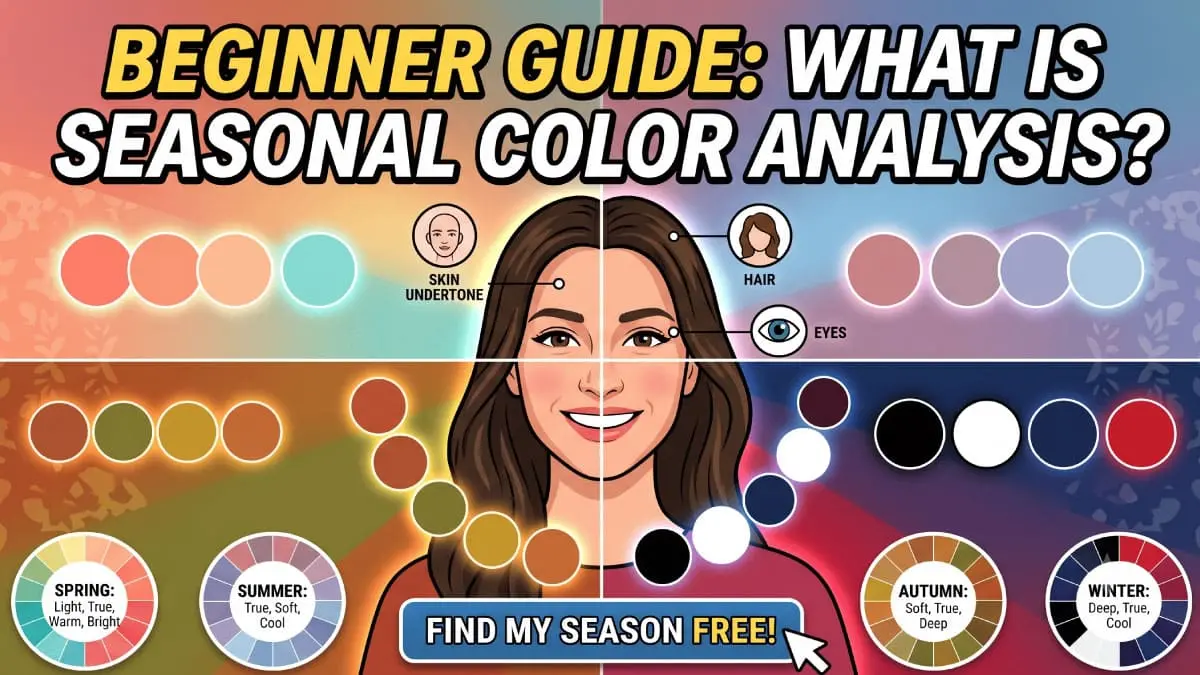
Every person has a natural coloring — a combination of skin undertone, hair color, and eye color that is unique to them. Seasonal color analysis identifies the category that best describes that combination and assigns it to one of four seasonal types: Spring, Summer, Autumn, or Winter.
Within each season is a family of colors that shares the same fundamental temperature and quality as the person wearing them. When you wear colors from your family, they harmonize with your natural coloring — your skin looks clearer, your eyes look brighter, and your features look more defined. When you wear colors from the wrong family, the opposite happens: you look tired, washed out, or slightly unwell, without knowing exactly why.
The effect is immediate and visible. Hold a color from your season and a color from the wrong season next to your bare face in natural light. The difference is apparent within seconds — one will make you look better and one will not, regardless of whether you personally like either color.
A Brief History of Seasonal Color Analysis
Johannes Itten — The Bauhaus Foundation
Swiss color theorist Johannes Itten, teaching at the Bauhaus in Germany, observed that his students instinctively chose colors that matched their own coloring when given free rein to select pigments. He noticed that warm-toned students gravitated toward warm palettes and cool-toned students toward cool ones. He began theorizing that personal coloring and color harmony were connected — the first documented link between personal coloring and color theory.
Suzanne Caygill — The Season Framework
American color consultant Suzanne Caygill developed the seasonal framework — assigning coloring types to the four seasons — in the 1970s. Her approach was holistic and artistic, using seasonal metaphors to describe not just color palettes but personality and style. Her 1980 book Color and You laid the groundwork for what was to follow.
Carole Jackson — Color Me Beautiful
Image consultant Carole Jackson popularized seasonal color analysis globally with her 1980 book Color Me Beautiful. It became an international bestseller and introduced millions of people to the four-season system. Jackson's approach was practical and accessible — she simplified the framework into four clear categories with concrete color recommendations that anyone could apply immediately.
The 12-Season System
As the practice matured, professional analysts found the four-season model too broad. People on the boundaries between seasons did not fit neatly into one category. Practitioners including Christine Scaman and Kathryn Kalisz developed the 12-season system — dividing each of the four seasons into three sub-seasons to give more precise palettes. The 12-season system is now the standard in professional color analysis practice. Read our complete guide to all 12 color seasons.
The TikTok Revival and AI Tools
Seasonal color analysis experienced a massive revival on TikTok and Instagram from 2022 onward, introducing a new generation to the practice. Simultaneously, AI tools made it possible to automate the analysis — using computer vision to detect skin, eye, and hair colors and map them to seasonal types. SeasonalColorAnalysis.net was rebuilt in 2026 with free AI-powered tools to make professional-quality analysis accessible to everyone.
Why Do Colors Look Different on Different People?
The science behind seasonal color analysis comes down to color temperature and optical contrast. Every color has a temperature — warm colors lean toward yellow and orange, cool colors lean toward blue and purple. Your skin has an underlying temperature too — either warm (golden, peachy, or olive-based) or cool (pink, rosy, or blue-based). You can confirm yours with our skin undertone guide.
When you wear a color whose temperature matches your skin's undertone, the two harmonize — they are in the same color family and reinforce each other. The visual effect is that your skin looks more even, your features look more defined, and your natural coloring appears at its best. This is not subjective — it is measurable in the change in how people perceive you.
When you wear a color with the opposite temperature, the clash is visible. A warm person in cool grey looks slightly sallow. A cool person in warm orange looks slightly flushed or unwell. Neither person looks "bad" — but both look less than their best. The wrong color is drawing attention to itself rather than drawing attention to you.
Color Temperature
Every color has a warm or cool base. Warm: yellow, orange, coral, warm red. Cool: blue, purple, pink, silver. Neutral: pure white, pure black. Your palette contains colors whose base matches your undertone.
Color Depth
Colors also vary in depth — from very light to very dark. Deep seasons need rich, dark colors. Light seasons need lighter, more delicate palettes. Wearing the wrong depth makes you look either overwhelmed or washed out.
Color Clarity
Colors range from vivid and clear to muted and greyed-down. Clear seasons suit saturated colors. Muted seasons suit soft, diffused palettes. Wearing the wrong clarity makes vivid colors overpower or muted colors look flat.
Contrast Level
High-contrast coloring — dark hair against light skin — suits bold, high-contrast outfits. Low-contrast coloring — features close in depth — suits tonal, blended outfits. Wearing the wrong contrast makes you disappear into your clothes or clash with them.
The Four Seasons
The four seasonal types form two warm-cool pairs. Spring and Autumn are warm-undertoned. Summer and Winter are cool-undertoned. Within each pair, one season is lighter and one is deeper.
Spring — Warm, Light, Clear
Warm golden undertones with light, clear, luminous coloring. Often warm blonde or light auburn hair and bright clear eyes. Colors that work: warm coral, peach, golden yellow, apple green, warm turquoise. Sub-seasons: Light, True, Warm, Bright Spring.
Summer — Cool, Soft, Muted
Cool undertones with a soft, powdery, gently muted quality. Often ash blonde or ash brown hair and soft blue or grey eyes. Colors that work: dusty rose, lavender, powder blue, soft sage. Sub-seasons: True, Soft, Cool Summer.
Autumn — Warm, Deep, Earthy
The strongest warm undertones — golden, olive, or bronze skin with rich warm hair in auburn or copper and earthy hazel or amber eyes. Colors that work: rust, olive, mustard, copper, warm brown. Sub-seasons: Soft, True, Deep Autumn.
Winter — Cool, Deep, Clear
Cool undertones with high contrast and striking clarity between features. Often dark hair with lighter skin and striking eyes. Colors that work: true black, pure white, jewel tones, icy pastels. Sub-seasons: Deep, True, Cool Winter.
What Does a Professional Color Analysis Session Involve?
A professional in-person seasonal color analysis session — called a "draping" — involves a trained color analyst holding dozens of colored fabric swatches next to your bare face in controlled natural lighting. The analyst observes how each color affects your complexion — which shades make your skin look clearer, which make shadows appear, which brighten your eyes, and which make you look tired or unwell.
The process takes one to two hours and ends with a personal color swatch fan showing all the colors in your season. Sessions with trained analysts typically cost £150 to £400 in the UK and a similar range in the US and Europe. The result is highly accurate — a trained eye in controlled lighting is the gold standard for color analysis.
How to Use Your Color Season in Real Life
Knowing your season is only the start. Here is how to apply it practically across the areas where it matters most.
Shopping
Your season gives you a filter for every shopping decision. Before buying anything that will be near your face — tops, scarves, jackets — check whether the color is in your palette. This single habit eliminates most wardrobe mistakes.
Men's Wardrobe
Color analysis works exactly the same for men — the biology is identical. Knowing your season tells you which suit neutrals, shirt colors, and accessories actually work for your undertone. Read the full color analysis guide for men.
Makeup
Foundation, blush, eyeshadow, and lip color all follow the same seasonal principles. Warm seasons suit warm-toned makeup. Cool seasons suit cool-toned makeup. The wrong undertone in foundation is the most common makeup mistake.
Hair Color
Hair dye choices can work with or against your season. Warm seasons should stay in warm tones — golden, copper, auburn. Cool seasons suit ash, platinum, and cool brunette. The wrong hair color fights your undertone immediately.
How Accurate Is Seasonal Color Analysis?
In professional practice — a trained analyst with controlled lighting and physical fabric swatches — accuracy is very high. The physical draping process leaves little room for doubt because the effect of each color on the face is immediately visible to both analyst and client.
Digital tools are less precise because they depend on photo quality, lighting conditions, and the absence of makeup. Our photo tool uses Google MediaPipe to detect 468 facial landmarks and sample color values from the cheek, eye, and hair zones — giving a reliable result in good conditions. Our accuracy estimate for the photo tool in good natural lighting is 75 to 85 percent for the broad season, with additional narrowing toward a sub-season.
The conversational AI tool — Chroma — is often more accurate than the photo tool because it uses the same diagnostic questions as a human analyst and is not affected by lighting or photo quality. If you are unsure about a photo result, the chat is a reliable second opinion. For a full walkthrough of the process, read how to find your color season.
Seasonal Color Analysis — Common Questions
Ready to Find Your Season?
Now you know what seasonal color analysis is — here are the three ways to find your season on this site, all free.
Photo Analysis
Upload a selfie or use your camera. Our AI samples your skin, eye, and hair colors using computer vision and returns your season with a confidence score. Best result in natural daylight without makeup.
Try photo tool →Chat with Chroma AI
Chat with our AI color consultant Chroma. She asks the same diagnostic questions a professional analyst would — vein color, jewelry preference, sun reaction — and gives a complete season result with palette and style advice.
Chat with Chroma →8-Question Quiz
Take the quiz — vein color, sun reaction, jewelry preference, eye color, natural hair, and white vs cream. No photo needed. Most reliable method when you answer about your natural unaltered coloring.
Take the quiz →Start Your Free Seasonal Color Analysis
Photo tool, quiz, or AI chat — your season result in under 2 minutes, no signup required. Have questions first? Visit our FAQ page.